Hours
Monday to Friday: 9AM - 5PM


For the modern independent bike or outdoor shop, the barrier to entry for e-commerce has never been lower. You choose a platform, you connect your POS—whether it’s Work Bench, Lightspeed, Ascend, or Shopify—and you toggle the “sync” button. Suddenly, thousands of SKUs are live. You have an e-commerce site.
But there is a massive, expensive gulf between having e-commerce and running e-commerce.
Most shops exist in the former category. They treat their website like a digital utility—much like the electricity or the water bill. It’s just something that’s “on.” However, a website that is merely “on” is often a liability. It creates friction, displays bad data, and eventually, the shop owner decides that “online sales just don’t work for us.”
The reality is that e-commerce doesn’t fail because of the platform. It fails because of a lack of operational rhythm.
The “Set and Forget” Trap
The promise of the automated data feed is the greatest double-edged sword in specialty retail. On one hand, it’s the only way a small crew can manage a catalog of 10,000+ parts, garments, and accessories. On the other, it creates a “ghost town” effect.
When you rely entirely on an automated feed, you are at the mercy of the lowest common denominator of data. If a brand sends a spreadsheet with all-caps titles or missing weights, that’s exactly how it appears to your customer. This data quality isn’t just a minor annoyance; it affects your search ranking. According to Google Merchant Center’s product data specifications, high-quality, specific product data is a primary factor in whether your items appear in “Shopping” results or AI-generated snapshots.
More importantly, an automated feed has no sense of context. It doesn’t know that it’s 40 degrees and raining outside, yet your homepage is still featuring a “Summer Clearance” banner from last August. In a physical shop, you would never let a faded, irrelevant sign hang over the front door for six months. In e-commerce, it happens every day.
The Digital Floor Walk
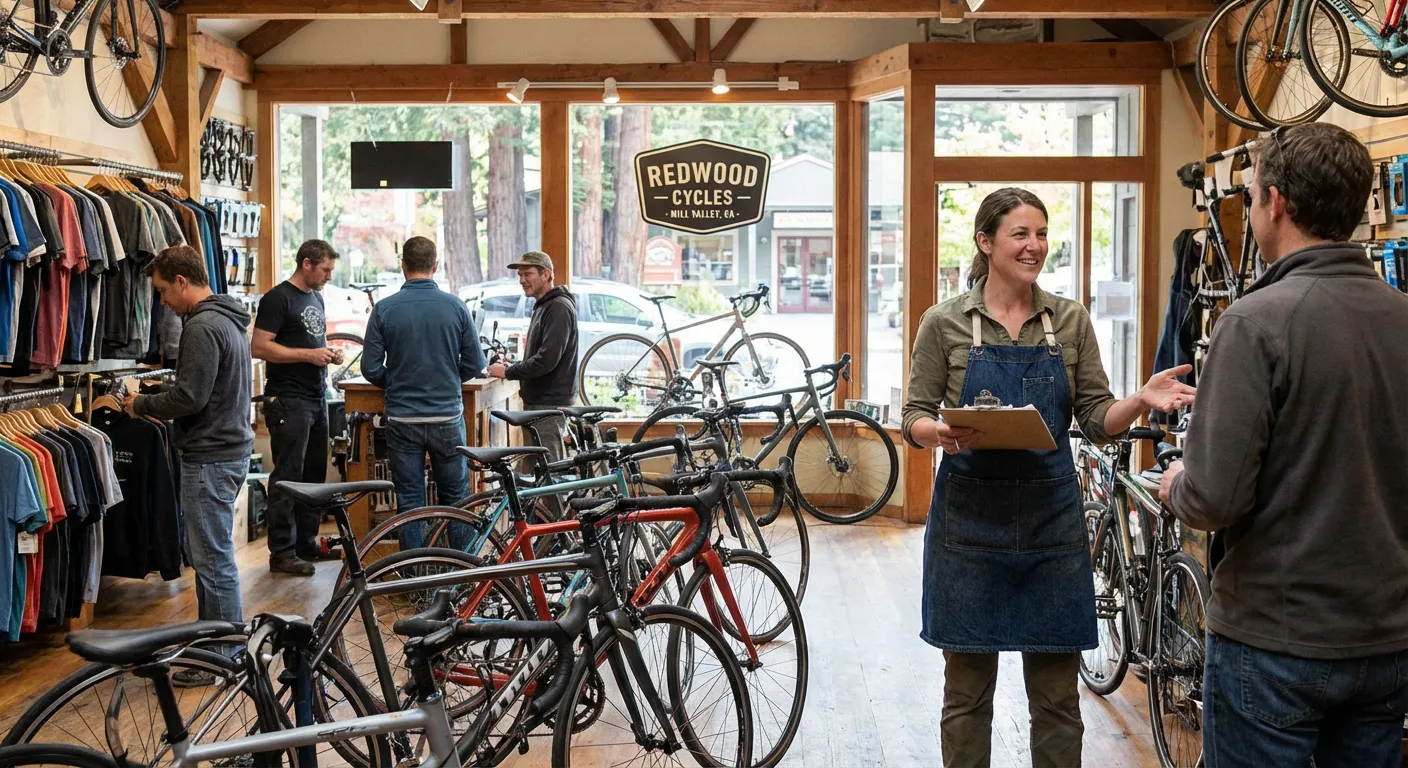
In a brick-and-mortar shop, the “floor walk” is instinctive. You walk in, straighten a row of helmets, check if the high-margin tires are eye-level, and make sure the trash is emptied.
Running e-commerce requires a Digital Floor Walk. This is a disciplined, weekly review of the site from the perspective of a customer who has never been to your town.
1. The Homepage Audit
Your homepage shouldn’t be a static museum. It should reflect the current season and the current pressure points of the shop.
- The “Above the Fold” Test: If I land on your site on a mobile phone, do I see what’s relevant right now? If it’s March, I should see tune-up packages and spring apparel, not leftover skis.
- The Link Check: Every seasonal banner must lead to a curated collection, not a “404 Not Found” page or a generic “All Products” list. Broken links are one of the fastest ways to kill “Domain Authority,” a concept Moz explains in detail as a predictor of how well you’ll rank in search engines.
2. The Search Experience
Most shop owners never use their own site’s search bar. Try it. Search for “Gravel tires” or “Water bottle cage.”
- Are the results relevant?
- Are the first three items actually in stock?
- Is the “Sort by” default showing the oldest products first or the newest?
3. Merchandising the “Middle”
The biggest missed opportunity in specialty e-commerce is the middle of the catalog. We all focus on the $6,000 bikes, but the profit is often in the accessories. “Running” e-commerce means ensuring that when someone looks at a bike, the “Suggested Products” aren’t random—they are the tubes, cages, and pedals that actually fit that bike. This is known as “Information Gain” in the SEO world—providing the customer with the specific next step they didn’t know they needed.
The Hidden Cost of Bad Data
We often hear shop owners say, “I don’t have time to fix product descriptions.”
Here is the operational reality: If you don’t spend the time to fix a confusing product description online, you will spend that time (and more) on the phone answering the same question for a frustrated customer. Or worse, you’ll spend it processing a return because the customer bought the wrong part.
Bad data is a customer service tax. Industry reports from Bicycle Retailer and Industry News (BRAIN) often highlight that technical “friction” is a leading cause of specialty shops losing market share to direct-to-consumer (DTC) brands who obsess over product page clarity.
E-commerce as a Support to the Shop Floor
One of the most common misconceptions is that e-commerce is a competitor to the physical shop floor. Shop owners worry that if they focus on the website, they are neglecting the “real” customers.
In 2026, the website is the front door. Even your most loyal local customers are checking your site at 9:00 PM on a Tuesday to see if you have a specific brake pad in stock before they drive over on Wednesday. Research on ROPO (Research Online, Purchase Offline) behavior shows that for specialty goods, the majority of in-store sales now start with a digital session.
If your site says “In Stock” but the item is actually buried in a back-stock bin and unfindable, you’ve broken trust. If the site says “Out of Stock” but you actually have three on the wall, you’ve lost a sale. Running e-commerce means tightening the loop between your physical inventory and your digital presence.
Why Consistency Beats “Big Swings”
Many shops try to “fix” their e-commerce with a massive, expensive site redesign every three years. They spend $20,000 on a new look, feel great for a month, and then let it sit and rot for another three years.
This is the “Big Swing” mentality, and it rarely works in specialty retail.
The shops that are winning at e-commerce are the ones that make marginal gains every single week. They spend two hours a week cleaning up categories. They update their shipping rates when carriers change. They swap out three photos. They refine one email flow.
As noted by Nielsen Norman Group, incremental improvements based on user behavior are far more effective at increasing conversion than a “flashy” overhaul that changes the navigation patterns your regular customers have already learned.
Who is Running Your Store?
If you are a shop owner, your time is best spent on the floor, managing your crew, and talking to your community. You shouldn’t be the one resizing images for a homepage slider or troubleshooting a broken CSS element.
But someone has to do it.
You can’t delegate e-commerce to “the kid who’s good with computers” in the back of the shop. They have bikes to build. You can’t leave it to a generic agency that doesn’t know the difference between a 12-speed chain and a 10-speed.
You need a crew that understands the cadence of a specialty shop—the way seasons shift, the way “pre-season” orders work, and the way a service department operates.
The Bottom Line
Having an e-commerce site is a technical hurdle you’ve likely already cleared. Running e-commerce is an operational discipline.
It’s about making sure your digital shop is as clean, organized, and welcoming as your physical one. It’s about realizing that “invisible” work—the cleanup, the maintenance, the constant tiny optimizations—is actually the most important work you can do for your brand’s future.
This is the kind of work Upline helps shops stay on top of. We don’t just give you a site; we help you run it, so you can get back to the floor.