Hours
Monday to Friday: 9AM - 5PM

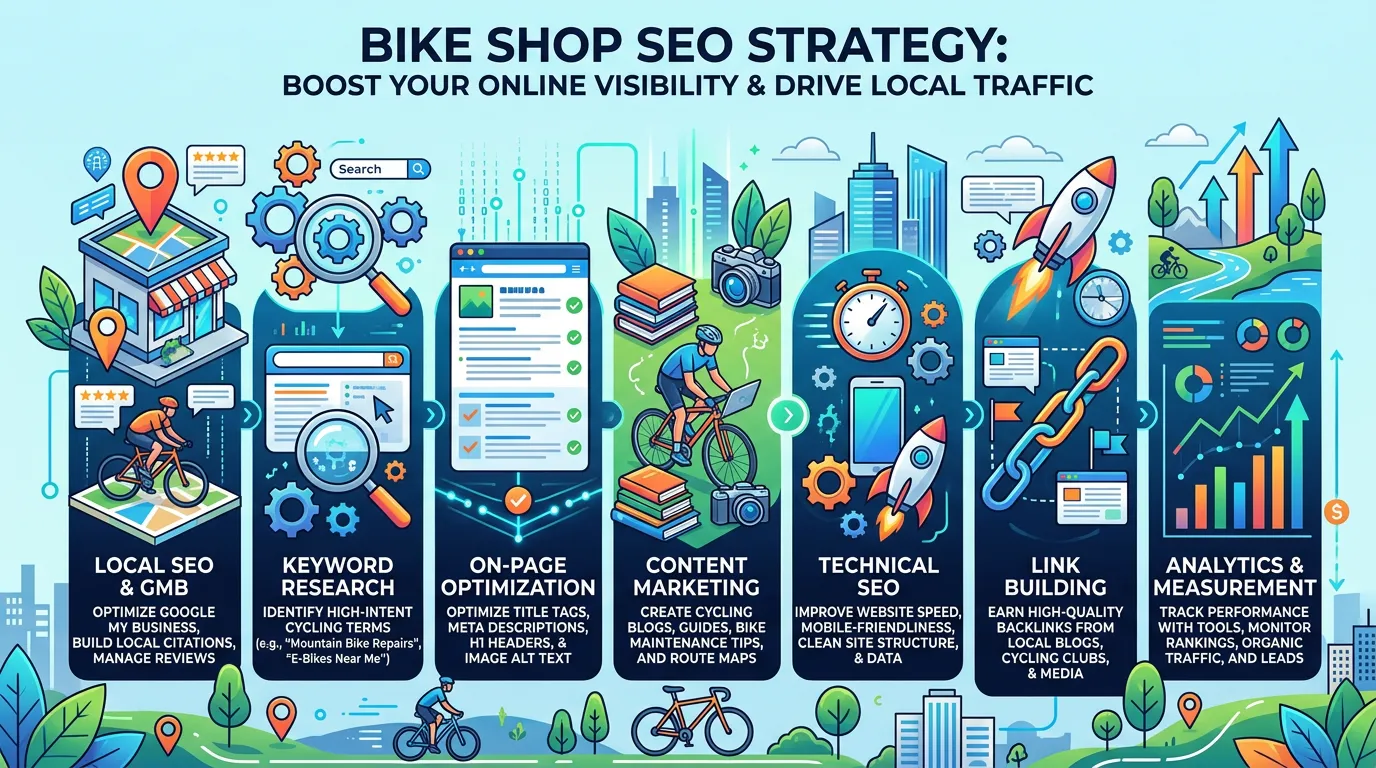

When someone in your city types ‘bike shop near me’ or ‘Trek dealer [city name]’ into Google, where does your shop show up? For most independent shops, the honest answer is: not where it should be. And the gap between where you are and where you should be is almost always fixable with the right attention in the right places.
This is a practical guide to bike shop SEO — specifically local SEO, which is the type that actually drives real customers to real shops.
Local SEO vs. Regular SEO: What’s the Difference for a Bike Shop
Regular SEO is about ranking for terms people search anywhere. Local SEO is about showing up in searches that have local intent — ‘near me,’ city-specific searches, and ‘open now’ queries. For a brick-and-mortar bike shop, local SEO is almost entirely what matters. You’re not trying to rank nationally for ‘best carbon road bike’ — you’re trying to own your market area.
Step 1: Get Your Google Business Profile Right
This is the single most important thing a bike shop can do for local SEO. Your Google Business Profile (GBP) is what appears in the map results — the three-pack that shows up above organic search results for local queries. If your GBP is incomplete, inaccurate, or inactive, you’re invisible to the people most likely to walk through your door.
Make sure:
- Your business name, address, and phone number are exactly correct and match what’s on your website
- Your hours are current — including holiday hours — and updated immediately when they change
- Your business category is ‘Bicycle Shop’ (and add secondary categories like ‘Bicycle Repair Shop’ if applicable)
- You have at least 10 photos — interior, exterior, staff, bikes on the floor
- You’re actively collecting and responding to Google reviews
- You’re using the Posts feature to share seasonal updates, events, and promotions
Step 2: Fix the NAP Consistency Problem
NAP stands for Name, Address, Phone number. Google cross-references your business information across dozens of directories — Yelp, Yellow Pages, Bing Places, Apple Maps, and others. If your information is inconsistent across these directories — different phone numbers, old addresses, name variations — it creates a trust signal problem that hurts your local rankings.
Do a quick audit: search your shop name and see what comes up. Check Yelp, Bing Places, and Apple Maps specifically. If the information is wrong or inconsistent, fix it.
Step 3: Make Sure Your Website Has the Right Local Content
Your website needs to clearly and consistently communicate where you are and what you do. This sounds obvious, but a surprising number of shop websites don’t have the city name on the homepage, don’t have a proper contact page with a full address, or have their hours buried three clicks deep.
At minimum, your homepage should include your city and region, your address, and your phone number. Your footer should repeat this information. A dedicated ‘Contact and Hours’ page should exist and be easy to find.
Beyond the basics, locally-relevant content helps. A page about local riding in your area, a blog post about trails near your shop, or a guide to cycling events in your city gives Google something local to index and signals that your business is genuinely embedded in the community.
Step 4: Understand How Your Platform Handles SEO
If you’re on Workstand, some SEO groundwork is done for you — the platform is built with SEO in mind and includes Google Merchant Center integration. But platform SEO is a floor, not a ceiling. The content layer, the local signals, and the active management are still your responsibility.
Shopify-based setups with Masterlinq or Frengee have strong SEO capabilities but require more active configuration. Make sure your meta titles and descriptions are customized (not auto-generated from feed data), your site speed is optimized, and your image alt text is filled in.
Step 5: Build a Simple Content Strategy Around Local Keywords
Even one blog post per month targeting local keywords builds meaningful SEO equity over time. Topics that work well for bike shops:
- ‘Best mountain bike trails near [city]’
- ‘[City] cycling events calendar [year]’
- ‘How to choose a bike for [local terrain type] riding’
- ‘Bike commuting in [city]: what you need to know’
These posts won’t go viral. They’ll quietly build local authority over 12 to 18 months while every shop around you stays quiet.
| Local SEO compounds. A shop that starts posting consistent local content and maintaining a clean Google Business Profile today will have a meaningful advantage over competitors who don’t within a year — and that advantage gets harder to close over time. |
| Sound familiar? If your shop is running one of these platforms and the online side isn’t keeping up with the shop floor, that’s exactly what Upline works on. No pitch, no pressure — just a straight conversation about what’s going on and whether we can help. Contact Upine for Help with Bike shop SEO |